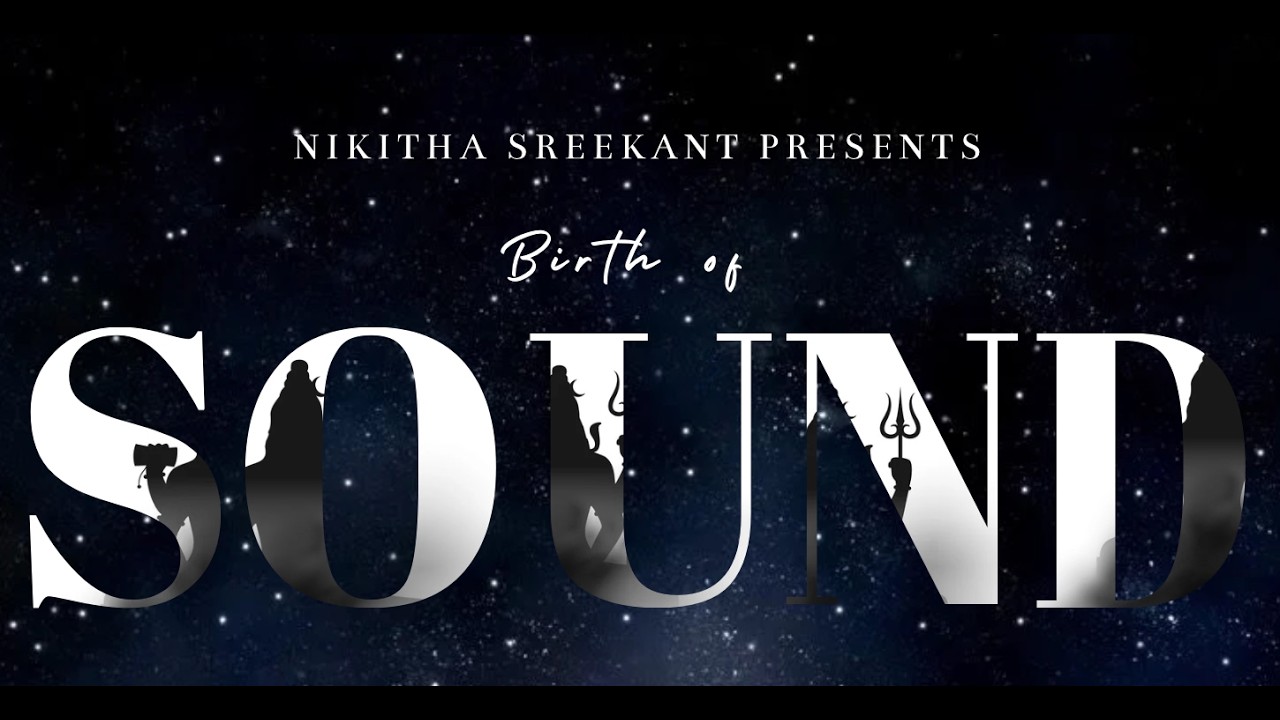
From the Silence Before Creation, Shiva Strikes His Drum


Birth of Sound is a solo Bharatanatyam production that traces the cosmic origin of music, rhythm, and dance — from the primordial vibration of Shiva's damaru to the full flowering of Natyam as sacred art.
Rooted in deep research into the Shiva Sutras, the Sangeetha Ratna Kara, and the Natya Shastra, this work follows a single unbroken thread: how sound was born, how it became mantra, how mantra became melody, how melody found rhythm, and how rhythm and movement became Natyam — the divine art.
One body. One stage. Four movements. A universe listening.
नृत्तावसाने नटराजराजो ननाद ढक्कां नवपञ्चवारम् ।
उद्धर्तुकामः सनकादिसिद्धान् एतद्विमर्शे शिवसूत्रजालम् ॥
"Nṛttāvasāne naṭarājarājo nanāda ḍhakkāṃ navapañcavāram —
Uddhartu kāmaḥ sanakādi siddhān etad vimarśe śivasūtrajālam" —
At the end of the cosmic dance, the king of dancers sounded his drum nine and five times;
wishing to uplift Sanaka and the other siddhas, this web of Shiva Sutras was revealed
through his divine contemplation.
The production moves through four distinct but inseparable phases — each one a deepening of the last. Sound becomes mantra. Mantra reveals melody. Melody calls for rhythm. Rhythm becomes dance. And dance reveals the divine.
Before anything existed, there was silence. Then Shiva danced, and struck his damaru. From those fourteen strikes, the Maheshwara Sutras were released — the seed-phonemes of creation, from which all language and all reality would unfold. This act opens in stillness, awakening only through rhythm.
The raga Śankarābharaṇam — one of the great ragas of Carnatic music — takes its name from Śankara's ābharaṇam: the ornaments of Shiva. This act explores the interpretation that the seven swaras — Sa, Re, Ga, Ma, Pa, Dha, Ni — are themselves Shiva's seven ornaments, emanating from his five faces, rising at the navel, enriched by the heart, and voiced through the throat. Each swara carries its own rasa, its own creature-voice, its own place in the cosmos — not merely notes on a scale, but living adornments of the divine.
Rhythm was born from the union of opposites. Shiva's Thandava — fierce, cosmic, masculine — and Parvati's Lasyam — graceful, tender, feminine — are not competing forces but complementary pulses. The Sangeetha Ratna Kara records how together they gave rise to Thalam: the rhythmic cycle that holds all music and dance in being. This act is a dialogue between stillness and movement, between creation and dissolution.
The Natya Shastra opens with Brahma declaring that he created a fifth Veda — the Natya Veda — drawn from all four existing ones, so that all people could access the divine. Natyam is not dance as entertainment; it is dance as scripture. This final act gathers all that came before — sound, mantra, melody, rhythm — and embodies them in the complete human form.
Birth of Sound is grounded in three foundational texts of the Indian classical tradition — each one a world unto itself, together forming the basis of how ancient India understood sound, music, and the performing arts.
The Shiva Sutras — also known as the Maheshvara Sutras — are fourteen foundational, aphoristic sound formulas that form the basis of Rishi Pāṇini's Aṣṭādhyāyī, the definitive text on Sanskrit grammar composed around the 4th century BCE. According to tradition, these phonetic formulas were revealed to Pāṇini by Lord Shiva's damaru drum — the cosmic origin point of this entire production.
The "Ocean of Music" — composed by Sharangadeva, this encyclopedic Sanskrit treatise is one of the most comprehensive texts on Indian classical music ever written. It describes the Sapta Swaras, their animal origins, the nature of nāda, and the relationship between sound and the body. Its first chapter, Svaragatadhyaya, forms the backbone of Act III.
The oldest surviving text on the performing arts in the world, attributed to the sage Bharata Muni. Spanning 36 chapters, it codifies every element of performance — gesture, expression, music, staging, and emotion. It begins with the creation of Natyam as a fifth Veda, revealing dance and drama as forms of knowledge as sacred as scripture.
This article explores how the raga Śankarābharaṇam takes its name from Shiva's
ornaments (ābharaṇam), and how the seven swaras emanate from his five faces —
the interpretive lens at the heart of Act III. Raman graduated from Kalakshetra
College of Fine Arts under its founder Rukmini Devi Arundale. As Patron and
Honorary Chairperson of the Melattur Bhagavata Mela Natya Vidya Sangam (1993–2002),
she curated five festivals of Bhagavata Mela Natakams across Mumbai, Chennai and
Thiruvaiyaru, and in 2002 produced a landmark Marathi Bhagavata Mela Natakam,
Sakuntala, written by the Thanjavur Maharaja Ekoji II. She is the author of
Bhagavata Mela — My Tryst with Tradition (Indus Source Books, 2018) and
continues her research through lectures on Bhagavata Mela Yakshaganams.
Read Article ↗
Nikitha Sreekant is a Bharatanatyam and Bharatanrityam artist with over 21 years of training under stalwarts such as Smt. Divya Shiva Sundar, Sri Kalakshetra Mohanan, and Smt. Ashwini Srivatsan. She began learning at age five and was blessed by The Dhananjayans to present her arangetram under Bharata Kalanjali (OMR Branch).
Known for her expressive abhinaya and research-driven choreography, Nikitha has presented solo works such as Shivarpitha and performed in Dr. Lakshmi Ramaswamy's Sundara Kandam and Smt. Jyotsna Vaidee's Earth Speaks 2.0, touring across North America.
"My journey is a celebration of heritage through movement."— Nikitha Sreekant
She is the founder of Nirmathi, a collaborative initiative creating interdisciplinary work rooted in classical traditions. She continues to choreograph and research independently, while balancing her career as a Financial Systems Product Manager at MongoDB and her MBA at the University of San Francisco.
Most recently, Nikitha presented Natya: A Living Archive at the San Francisco International Arts Festival 2026.

Photographer — Shveta Melpakkam


For booking enquiries, residency proposals, or to follow the development of this work, reach out below.